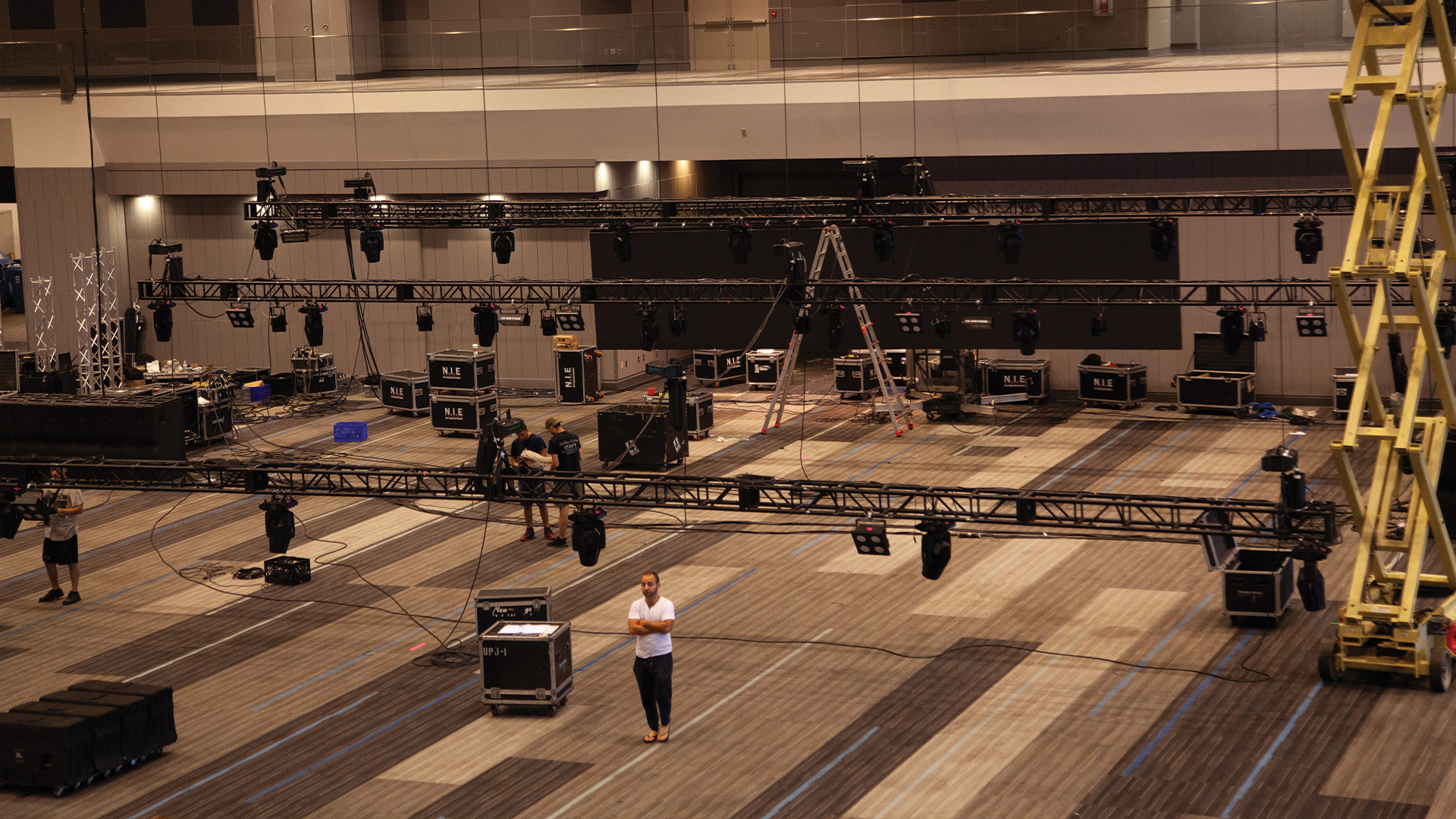
The aluminium trussing that supports modern stage productions carries enormous responsibility—literally tonnes of lighting fixtures, audio equipment, and video displays suspended above performers and audiences. These structural marvels typically remain silent partners in the entertainment equation. Occasionally, however, truss develops aspirations beyond its supporting role, deciding to become part of the performance in ways that terrify riggers and thrill nobody.
The Concert That Gained an Unscheduled Percussion Section
A touring production carrying an ambitious lighting rig arrived at a mid-sized arena with a design requiring Prolyte H40V truss in configurations pushing acceptable load ratings. The head rigger expressed concerns about certain spans, but pressure to maintain the touring design prevailed.
During the headliner’s pyrotechnic-heavy set, the heating effect from flame projectors positioned beneath the truss created unplanned thermal expansion. The aluminium members began moving at connection points—barely perceptible initially, then increasingly dramatic. By the third song, the truss grid had developed a rhythmic creaking that harmonised disturbingly with the bass frequencies.
The production manager watched helplessly as their carefully planned lighting positions shifted centimetres in multiple directions. Moving head fixtures—a combination of Robe BMFL Blades and Martin MAC Ultra Performance—found themselves pointing at unexpected locations despite accurate programming. The truss had decided to dance along with the music, adding its metallic voice to the percussion section.
The Engineering Heritage of Stage Trussing
Modern entertainment trussing evolved from industrial scaffolding applications, adapted specifically for the unique demands of touring production. James Thomas Engineering—founded in 1978—pioneered many configurations still in use today. Their collaboration with lighting companies established standard truss specifications that enabled equipment interoperability across the industry.
The development of the conical coupler system revolutionised truss assembly, replacing slower bolt-together connections with quick-lock mechanisms that drastically reduced setup times. Manufacturers including Prolyte, Global Truss, Tyler Truss, and MILOS refined these systems, each bringing proprietary innovations while maintaining compatibility with industry standards.
The Theatre Installation That Developed Stage Presence
A permanent installation at a performing arts centre featured automated truss systems controlled via chain hoists with SIL 3 safety-rated controllers. The Kinesys Apex system managing the automated elements represented state-of-the-art motion control technology, with redundant safety mechanisms throughout.
During a prestigious ballet performance, the upstage lighting batten began descending without command. The dancers continued their choreography as the truss bearing 30 ETC Source Four fixtures slowly approached head height. The automation technician frantically engaged emergency stop protocols, but the system’s response lagged several critical seconds.
Investigation revealed a firmware bug that interpreted certain lighting console DMX commands as motion cues. The grandMA2 lighting console was sending RDM discovery requests that the automation system’s legacy interface misread. The truss was responding to lighting data meant for fixture identification, translating those signals into movement commands.
Load Calculations and Safety Margins
Professional rigging calculations incorporate multiple safety factors mandated by regulations including ANSI E1.4 in North America and BS 7906 in the United Kingdom. These standards require design factors typically of 5:1 for static applications and 10:1 for dynamic scenarios—meaning structures must support five to ten times their anticipated loads before failure.
Software tools including MILOS Structural Design Software, Vectorworks Braceworks, and Prolyte’s calculation tools enable riggers to model complex assemblies before physical construction. These applications consider point loads, distributed weights, cantilever moments, and dynamic forces from automation movements.
The Festival Ground Stack That Sought Freedom
An outdoor festival deployed ground-supported truss structures when venue restrictions prohibited overhead rigging. The goal post configuration featured TOMCAT Medium-Duty truss on Omega steel base plates with calculated ballast weights to resist anticipated wind loads.
Weather forecasts predicted mild conditions. Reality delivered unexpected wind gusts exceeding 60 km/h during setup. The structural engineer on-site recalculated requirements and ordered additional ballast deployment. Before the concrete blocks could be positioned, the partially loaded structure began walking across the production area—the base plates sliding incrementally with each gust, equipment dangling from increasingly concerning angles.
The crew established temporary guy-wire stabilisation using ratchet straps anchored to loaded transport vehicles—an improvised solution that would horrify any certified rigger but prevented immediate disaster. The structure had clearly decided that remaining stationary didn’t suit its adventurous personality.
The Role of Professional Certification
The Entertainment Technician Certification Program (ETCP) establishes professional standards for arena and theatre riggers. Certification requires demonstrated knowledge of rigging mathematics, hardware specifications, inspection procedures, and safety regulations. Many venues and production companies now mandate ETCP certification for personnel working at height.
Training organisations including Sapsis Rigging, the PLASA Rigging Pathway, and various manufacturer-specific programmes provide essential education. Understanding force vectors, sling angles, and working load limits prevents the scenarios where truss decides to become an active participant rather than passive support.
The Arena Tour That Experienced Resonance Issues
A heavy metal tour featuring extensive pyrotechnic effects and substantial subwoofer deployment encountered unexpected structural behaviour. The James Thomas SuperTruss grid supporting the lighting rig began exhibiting harmonic resonance during songs with sustained low-frequency content.
The d&b audiotechnik SL-SUBS in cardioid configuration were generating enough acoustic energy to excite the truss structure’s natural frequency. Moving head fixtures mounted to the vibrating structure produced visible oscillation, creating unplanned strobe effects as beams traced small circles rather than holding steady positions.
The system engineer implemented parametric EQ notch filtering at the offending frequencies—a compromise that reduced the problem while marginally affecting the audio experience. The truss had effectively become part of the band’s performance, adding its own rhythmic contribution to every bass-heavy track.
Preventive Measures and Best Practices
Keeping truss in its supporting role rather than allowing it to join the performance requires systematic approaches to design, installation, and monitoring. Pre-production structural analysis should account for all anticipated loads including dynamic forces, thermal effects, and acoustic energy transmission.
Regular inspection protocols catch degradation before failure. Visual inspection of welds, connections, and overall geometry should occur before every use. Non-destructive testing including dye penetrant inspection reveals cracks invisible to casual observation. Truss with any concerning signs should be immediately removed from service.
Modern load monitoring systems from manufacturers like Broadweigh and Loadguard provide real-time weight data from critical points. These systems alert crews to unexpected load changes before structural limits are approached. Combined with motion sensors and accelerometers, comprehensive structural health monitoring catches truss attempting to develop performance aspirations early enough for intervention.
The truss structures that attempt to join bands remind us that even the most stable equipment requires constant vigilance. Their occasional performances—however unwanted—teach valuable lessons about engineering margins, environmental factors, and the importance of respecting physical limitations. The best riggers approach every installation assuming the truss might have its own agenda, building in safeguards that keep aluminium frameworks firmly in their supporting roles.
