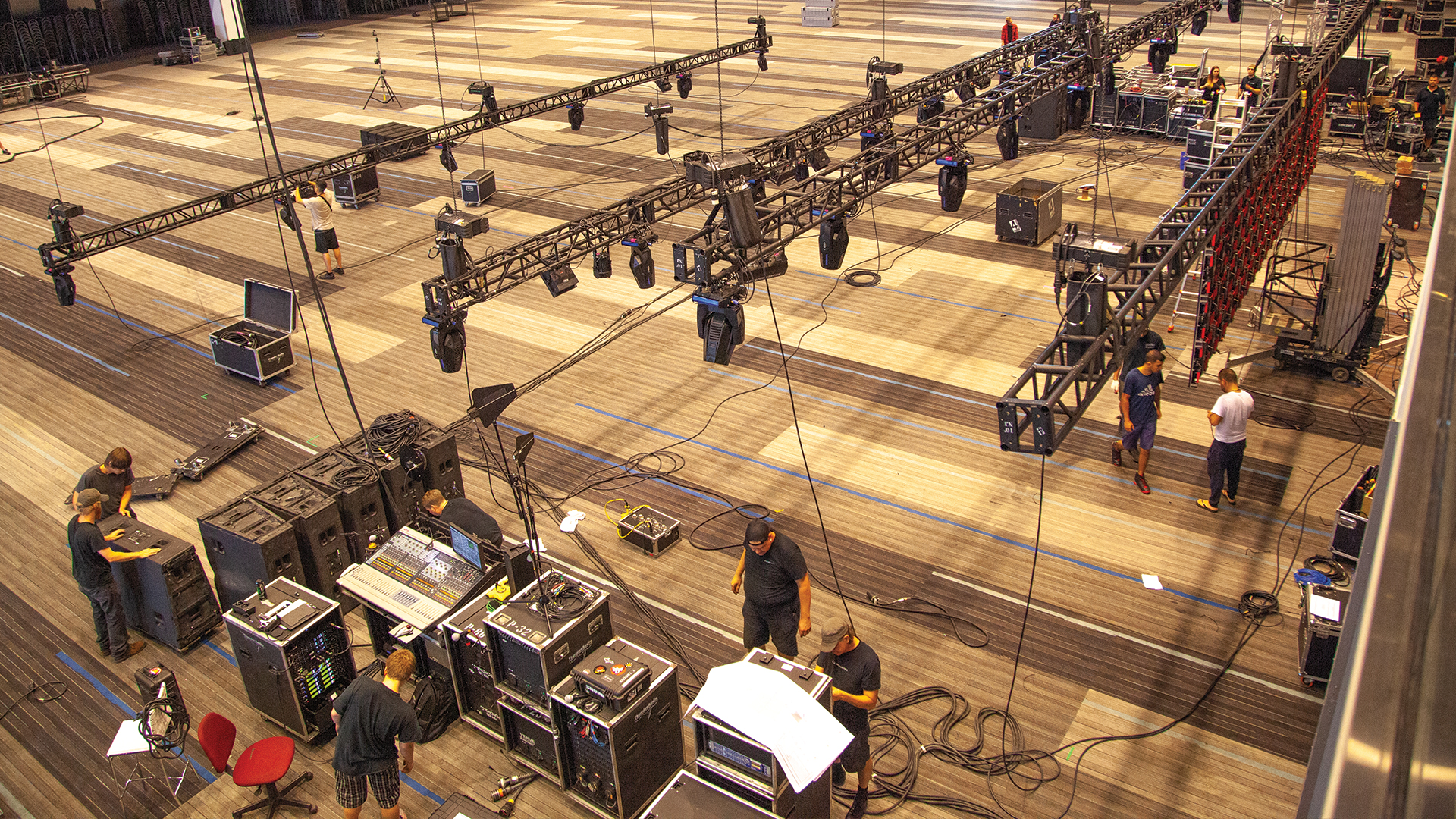
The production convoy stretched across two miles of interstate, twelve tractor-trailers carrying everything needed for an arena spectacular: L-Acoustics K1 arrays, ROE Visual LED panels, Tyler GT truss, and enough Robe moving lights to illuminate a small city. Then the blizzard arrived eighteen hours early, and the tour manager found herself making decisions that would determine whether twenty thousand ticket holders would see their show—or watch from home as their money got refunded.
Logistics as Performance Art
Modern touring production logistics operates with margins tighter than most civilians realize. The trucks rolling toward the next venue carry equipment that was being struck at the previous venue just hours earlier. Load-in crews often begin work before dawn, racing to build productions that took weeks to design in a single day. Any disruption—weather, mechanical failure, traffic—propagates through the schedule with compounding consequences.
The snowstorm scenario follows a predictable pattern for tour production managers. Weather forecasts are monitored obsessively for days in advance. Alternative routing is researched. Local crew calls are adjusted based on predicted arrival times. The decisions happen in stages: first, determining if the show can proceed at all; second, figuring out how to make it happen if it can.
The Great Blizzard Decision
That particular storm caught everyone off guard. The National Weather Service had predicted significant snowfall, but the system’s acceleration meant heavy snow began falling during daylight hours instead of overnight as forecast. The tour convoy was still four hours from the venue when highway conditions deteriorated from manageable to dangerous.
The production manager faced an impossible calculus. Pushing forward risked driver safety and equipment damage. Stopping meant missing load-in entirely—no show, twenty thousand disappointed fans, massive financial losses, and potential contractual penalties. She convened a rapid conference call with the trucking coordinator, the venue’s head stagehand, and the artist’s management. The decision: stage the trucks at a rest stop and reassess in two hours.
The Emergency Protocol
Major touring productions develop contingency plans for exactly these scenarios. The protocol for this tour specified a hierarchy of fallback options: full show, reduced show with essential elements only, or cancellation. Each option had defined trigger points based on equipment arrival times and local crew availability.
The venue production manager proved invaluable. She’d managed that arena through fifteen years of weather emergencies and knew which local crew members lived close enough to arrive despite road conditions. She began calling those stagehands personally, offering premium rates for guaranteed arrival. Within an hour, she’d assembled a skeleton load-in crew that could begin work the moment any truck arrived.
The Truck Ballet
Standard truck pack for arena tours places equipment in a precise order: items needed first in load-in positioned for last-off-truck access. The rigging hardware and chain motors typically ride in the front of certain trucks, allowing riggers to begin flying points while other equipment unloads. This sequencing assumes all trucks arrive together or in a specific order.
The blizzard shattered that assumption. Trucks arrived over a four-hour window depending on which routes drivers chose and which segments got plowed first. The crew chief improvised a modified load-in sequence, beginning with whatever equipment was available rather than waiting for the optimal order. When the lighting truck arrived before the rigging truck, the crew began prepping fixtures on the arena floor—unconventional but productive.
The Cold Truth About Equipment
Temperature presents its own challenges for production equipment. LED panels can develop condensation when cold equipment meets warm venue air. Moving head fixtures with motors cooled below operating temperature might bind or move sluggishly. Audio cable becomes stiff and difficult to route. The video engineer watched nervously as frost-covered LED cases came off the trucks.
The venue’s HVAC system became a tool for equipment conditioning. Cases were opened near heating vents to accelerate warming. Gel frames were placed on warm concrete rather than cold steel deck. The lighting crew powered up fixtures in stages, allowing internal heat to build gradually rather than stressing cold components with immediate full operation.
Communication Under Pressure
The Clear-Com production intercom system connected department heads throughout the crisis, but cell coverage in the loading dock proved unreliable, and key personnel spent significant time in trucks or parking areas with no intercom access. The production manager designated runners—crew members whose sole job was carrying information between disconnected locations.
Status updates went to the artist’s management every thirty minutes, each update recalibrating the probability of show completion. The venue operations team communicated with ticket holders through social media, advising delayed doors without committing to cancellation. This communication balance—maintaining hope without making promises—required diplomatic skills that no technical training provides.
The Abbreviated Aesthetic
By mid-afternoon, it became clear that the full production couldn’t be achieved. The lighting designer made painful decisions about which elements to prioritize. The elaborate automated truss choreography was abandoned in favor of static positions that could be achieved faster. The LED wall was reduced from full 360-degree surround to front-stage only. The FOH mix position was moved from ideal placement to wherever space allowed.
The audio system engineer faced similar compromises. The delay towers that would normally extend coverage to distant seats couldn’t be deployed in time. The subwoofer array was simplified from cardioid configuration to standard forward-facing deployment. The Meyer Sound Galileo processor optimization that normally takes hours was abbreviated to essential alignment only.
The Moment of Truth
Doors opened ninety minutes late to an audience that had braved the same storm to attend. The house lights remained up in sections where rigging wasn’t complete. The production stage manager ran a modified cue sequence that accounted for elements that didn’t exist. Crew members continued working in visible positions throughout the show, completing tasks during songs rather than between them.
The audience, having invested their own effort to attend through the blizzard, proved remarkably forgiving. The reduced production still exceeded what most venues could achieve under normal circumstances. The artist acknowledged the circumstances from stage, creating a shared-adversity narrative that transformed potential disappointment into communal experience. What could have been a disaster became a story—one that crew and audience would tell for years.
Lessons Frozen Into Memory
The snowstorm show generated a detailed after-action report that influenced subsequent tour planning. Future routings included greater buffer time during winter months. Equipment cases were modified to include insulation and moisture barriers. The production protocol now includes specific triggers for early staging decisions rather than hoping conditions improve.
The trucking company added weather monitoring capabilities to their dispatch operation, providing tours with earlier warning about developing conditions. Driver communication protocols were formalized: regular check-ins during adverse conditions, clear authority to stop safely rather than push through dangerous situations. The industry-wide recognition that production never justifies risking driver safety was reinforced.
The Economics of Weather
Insurance and force majeure clauses in touring contracts exist precisely for situations like blizzards. But invoking those clauses has cascading consequences: refund processing, venue compensation negotiations, rescheduling complexities, and reputation considerations. The financial incentive to make shows happen, even in compromised form, is substantial.
The tour accountant later calculated that the blizzard show cost approximately forty percent more than a normal date due to premium local crew rates, equipment repairs, and schedule adjustments. That cost was far less than cancellation would have imposed. The decision to persist, made under extreme time pressure with incomplete information, proved financially sound—though the production manager admits she was simply refusing to accept failure more than calculating outcomes.
Building Resilient Touring Operations
The best touring productions build resilience into their DNA. This means equipment redundancy—backup console surfaces, spare fixtures, extra cable. It means personnel depth—cross-trained crew members who can cover multiple departments. It means relationships—knowing which local vendors can provide emergency support, which venue staff will go above and beyond, which trucking companies maintain equipment properly.
Most importantly, resilience means mindset. The crews that survive blizzards, equipment failures, and venue surprises share a refusal to accept that the show cannot happen. They find solutions that textbooks don’t describe. They improvise with available resources. They maintain communication when systems fail. They support each other through exhaustion and stress. This cultural resilience, more than any specific equipment or protocol, determines which tours survive their inevitable disasters.
That blizzard show became a bonding experience for the crew that worked it. Years later, veterans of that night recognize each other at industry events, sharing the look of people who’ve been tested and succeeded. The production manager keeps a photo from that load-in on her office wall: trucks barely visible through driving snow, crew members in parkas wrestling road cases across icy loading docks. It reminds her that tours don’t survive on good weather—they survive on good people making good decisions when everything goes wrong.
Keywords: production convoy, L-Acoustics K1, ROE Visual LED panels, Tyler GT truss, Robe moving lights, touring production logistics, load-in crews, tour production managers, tour convoy, production manager, trucking coordinator, head stagehand, touring productions, local crew availability, venue production manager, load-in crew, truck pack, rigging hardware, chain motors, crew chief, production equipment, LED panels, moving head fixtures, audio cable, video engineer, gel frames, lighting crew, Clear-Com production intercom, venue operations team, lighting designer, LED wall, FOH mix position, audio system engineer, subwoofer array, Meyer Sound Galileo processor, house lights, production stage manager, after-action report, equipment cases, production protocol, trucking company, force majeure clauses, touring contracts, tour accountant, console surfaces, touring productions
