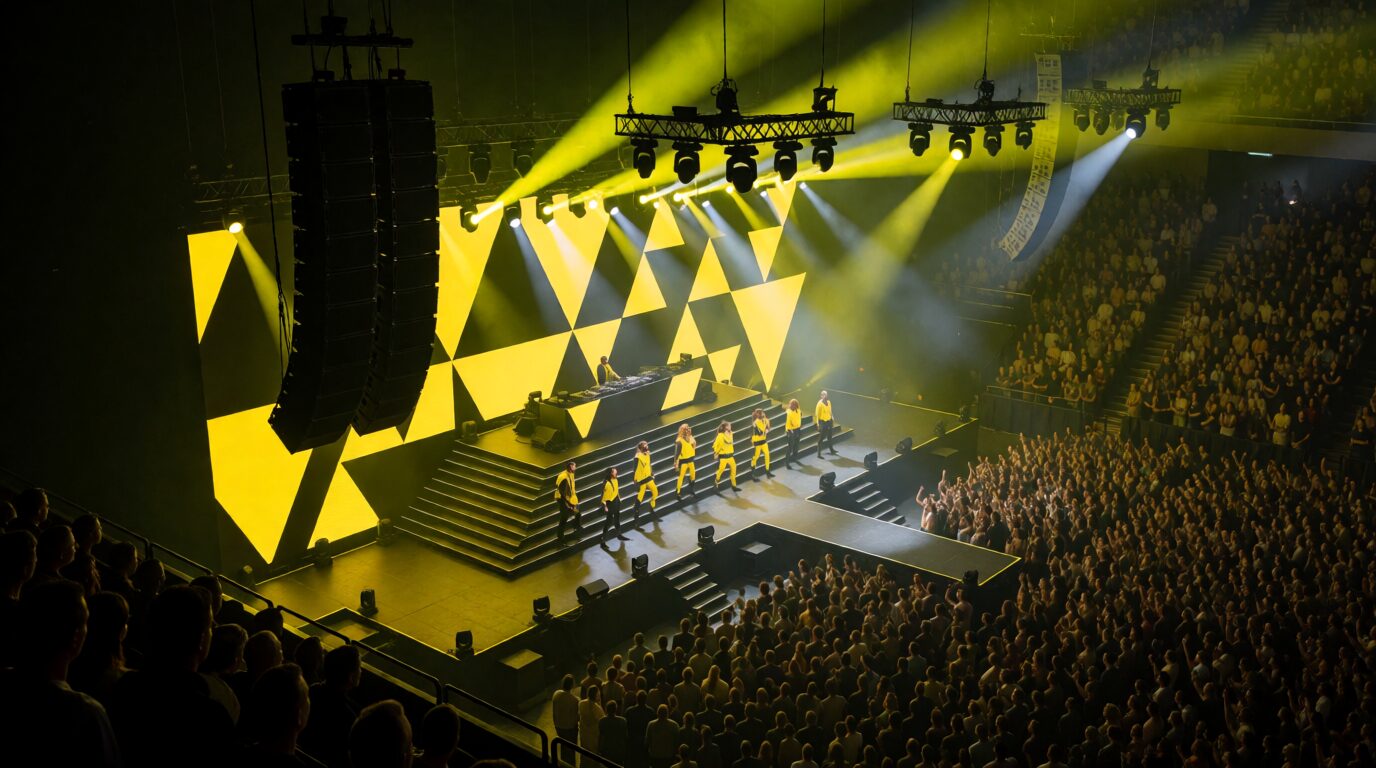
Picture the finale of a rock show, composite and anonymous but familiar to anyone who has worked a few seasons. The band hits the last chorus, the stage manager calls “Standby pyro, standby haze, standby lighting 400,” and somewhere between the call and the go, a single assumption collapses. The haze operator thinks the cue is on the downbeat, the pyro tech thinks it is on the second beat, and the lighting programmer has quietly built the blackout for the third. The result is a fumbled cue: flame in the dark, fog arriving late, and a drummer wondering why the finale looks like a rehearsal. Nobody was hurt. Everybody learned. That is the usual shape of these stories.
Why Fog and Fire Are the Hardest Cues
Fog and fire share a nasty trait: they are physical effects with latency. A flame projector responds in tens of milliseconds, a CO2 jet almost instantly, a confetti cannon in a tenth of a second or more, and haze drifts for seconds before it becomes visible. Lighting and video cues, by contrast, are nearly instantaneous. The mismatch means every effect needs its own pre-fire offset, and every offset needs to be measured, not guessed.
The industry has been chasing this problem since the 1970s, when KISS and Pink Floyd turned pyrotechnics into theater. Early shows relied on operators with fast reflexes. The arrival of MIDI Show Control in the 1990s and timecode-driven firing systems from Pyrodigital, Galaxis, and FireOne allowed effects to join the timeline. Yet the human layer, the calls and the assumptions, still decides whether a finale lands.
The Anatomy of a Fumbled Cue
Most fumbled cues have one of four causes. The first is ambiguous calling, where “on the downbeat” means different things to different people. The second is unmeasured latency, where an effect that fires “at the same time” arrives half a second late. The third is state confusion, where an operator does not know whether a system is armed, safe, or paused. The fourth is drift, where a timecode or tempo reference slides out of alignment during a long show.
Notice what is missing from the list: equipment failure. Most fumbles are communication failures wearing a technical costume. That is good news, because communication can be rehearsed.
Fix the Language Before the Hardware
Start with the cue call. Write every effect cue with three elements: the trigger (a lyric, a beat number, a timecode), the owner (who fires it), and the expected result (what the audience sees). A cue line should read: “Q400, pyro, bar 64 beat 1, flame bursts upstage left, lights blackout 0.5 seconds earlier.”
Use standard phrases over Clear-Com or RTS intercom: “Standby,” “Go,” “Hold,” “Armed,” “Safe.” Add closed-loop confirmation. When the stage manager says “Standby pyro,” the pyro operator replies “Pyro standing by, armed.” A thirty-second exchange eliminates the ambiguity that sinks finales.
Measure Latency With a Camera
Guessing latency is a fast route to embarrassment. Fire each effect during a safe test, and record it with a high-frame-rate camera or a phone in slow motion next to a timecode display or audio click. Count the frames between trigger and visible effect. Convert to milliseconds, and enter the value as a pre-fire offset in the cue list.
Document offsets in a table: effect type, location, offset, conditions. Wind, humidity, and fluid type can shift results, so retest in the real venue. Many teams keep a “latency card” taped to the show control desk, which is a small piece of paper that prevents big mistakes.
Make Arming Visible
Safety design and timing design converge on one idea: everyone must know the state of the system. Use tally lights, LED indicators, or a dedicated intercom call to signal “Pyro armed” and “Pyro safe.” Lighting and video operators should see the state at their positions, because a pyro cue that is safe will not fire no matter how perfectly the lighting cue lands.
Separate arming from firing physically and procedurally. A key switch, a dead-man handle, and a safety officer with a clear line of sight are standard. Respect NFPA 1126 in the United States and the local equivalent elsewhere, and keep licensed pyrotechnicians in charge of live effects. No timing optimization justifies skipping a safety step.
Let the Fog Do Its Job
Haze deserves the same rigor. A hazer such as the MDG ATMe or Look Solutions Unique 2.1 needs time to build and time to clear, and its density affects beam visibility, camera contrast, and LED wall contrast. Program haze cues early, ramping density thirty to ninety seconds before a big moment, and use DMX fan control to push or pull the atmosphere.
Remember fire alarms. Haze can trigger smoke detectors, so coordinate bypass with the venue and fire marshal well before doors. A haze cue that sets off a building alarm is the most expensive way to get attention.
Rehearse the Failure, Not Just the Success
A fumbled cue is only a disaster if nobody expects it. Build fallbacks into the lighting and video cues around each effect. If pyro does not fire, the lighting hit should still look intentional: a blackout and a flash read well even without flame. If haze is late, the video should carry the moment.
Run failure drills during tech. Tell the pyro operator to skip a cue and see what the others do. A team that has practiced a missed effect will handle a real one without a visible flinch. The audience cannot see what did not happen, only what the crew does about it.
The Business Case for Boring Preparation
Effects are expensive, and failures are public. A pyro package can cost thousands per show, and a mistimed finale can undermine an artist’s confidence and a client’s renewal. Preparation is cheap by comparison: an hour of latency testing, a one-page cue call sheet, a fifteen-minute failure drill.
Price this work into proposals. Clients who understand that effect integration requires testing time, licensed operators, and rehearsal will pay for it, especially if you can point to a track record. A reputation for clean finales is one of the most valuable assets a production company owns.
Practical Takeaways
Treat fog and fire as latency-bearing cues, and measure offsets with a camera. Write cue calls with trigger, owner, result, and use closed-loop confirmation. Make arming visible, respect safety standards, program haze early, coordinate fire alarms, and rehearse failure. Document latency and price preparation into proposals.
The Bottom Line
Fog, fire, and fumbled cues are the same story told three ways: timing is a team sport. When the language is clear, the latency is measured, and the state of the system is visible, a finale lands with the confidence of a drum fill. The audience sees spectacle, and the crew remembers the night the cue sheet saved the show.
