The first screech usually happens during soundcheck when someone walks a handheld microphone a bit too close to the wedge monitors. That piercing howl—the unmistakable signature of acoustic feedback—sends the audio engineer’s hands flying across the console to kill the offending frequency before it becomes painful. For anyone who has witnessed an uncontrolled feedback event tear through a venue, the sound burns into memory. Preventing that disaster defines much of what stage audio engineers do, employing techniques refined over decades to maintain the delicate balance between intelligibility, volume, and stability. The battle against feedback shapes every decision from microphone selection to speaker placement to real-time processing.
The Physics of Feedback Formation
Feedback occurs when a microphone captures sound from a loudspeaker, amplifies it, and returns it to the same loudspeaker in a continuous loop. The loop builds at frequencies where the gain exceeds unity—essentially, where the system amplifies sound more than the room absorbs it. The resonant frequency depends on the physical relationship between microphone and speaker, room acoustics, and the characteristics of all equipment in the signal chain. Change any variable and the feedback frequency shifts. A singer moving two feet closer to their monitor might transform a stable mix into a howling mess.
The concept of gain before feedback quantifies how loud a system can go before feedback begins. Different microphone patterns provide different inherent rejection of off-axis sound—a cardioid pattern attenuates sound from behind the capsule, while hypercardioid and supercardioid patterns offer tighter pickup patterns with rear lobes that must be considered in monitor placement. The Shure SM58 achieved legendary status partly because its cardioid pattern and frequency response provide excellent feedback rejection for vocal applications—it became the default handheld microphone for good reason.
Historical Evolution of Feedback Management
Early sound reinforcement faced feedback as an almost insurmountable challenge. Before sophisticated equalization tools existed, engineers relied entirely on physical solutions: positioning speakers carefully, choosing microphones with appropriate patterns, and accepting limitations on achievable volume. Bell Labs engineers studying the problem in the 1930s developed mathematical models describing feedback conditions, but practical solutions remained elusive. The Western Electric 618A microphone and similar early dynamics offered limited directional control, making feedback management primarily about keeping microphones far from speakers.
The introduction of graphic equalizers in the 1960s revolutionized feedback control. Engineers could now identify problematic frequencies and reduce their level without affecting the entire signal. The 1/3-octave graphic EQ became standard in professional audio, with 31 bands providing frequency-specific control across the audible spectrum. Klark Teknik DN360 and similar units appeared in every professional rack, their sliders adjusted through the careful process of ‘ringing out’ systems—gradually raising gain while notching problematic frequencies until acceptable headroom was achieved.
Ringing Out: The Traditional Approach
The classic technique for establishing system gain structure involves deliberately inducing feedback to identify problematic frequencies. The engineer slowly raises the gain on an open microphone while listening for the onset of feedback. When ringing begins, they identify the frequency—either by ear or using a real-time analyzer (RTA)—and apply a narrow cut at that frequency. The process repeats, gradually increasing available headroom while creating a notch filter constellation that tames the room’s resonant tendencies.
Experienced engineers develop remarkable pitch recognition through years of ringing out systems. The 250Hz boom, the 2kHz bite, the 4kHz ice pick—each feedback frequency has a characteristic sound that trained ears identify instantly. Software tools like Smaart from Rational Acoustics provide visual confirmation, but the fastest engineers combine ear training with measurement. The goal isn’t to eliminate all problematic frequencies—aggressive cutting hollows out the sound. Rather, it’s achieving sufficient headroom while maintaining natural tonal character. Typically, 6-10dB of headroom above working levels provides acceptable safety margin for typical stage applications.
Automatic Feedback Suppression Systems
Digital signal processing enabled automatic feedback detection and suppression that works faster than human reflexes allow. Sabine FBX pioneered this category in the early 1990s, using algorithms to distinguish feedback from program material based on the sustained, single-frequency nature of feedback howl. Modern implementations in processors from dbx, Behringer, and Shure (in their wireless receiver/processor combinations) provide nearly instantaneous notch filter deployment when feedback is detected.
Professional engineers approach automatic systems with appropriate skepticism. These processors can mistake musical tones for feedback, creating phantom notches that color the sound unnecessarily. They work best as safety nets rather than primary tools—catching incipient feedback before it becomes problematic while the engineer adjusts the underlying cause. The Shure PSM 1000 in-ear monitoring system includes automatic feedback suppression that protects performers’ hearing while allowing engineers to maintain traditional monitor mixing approaches. This hybrid philosophy—automated protection with manual primary control—reflects contemporary best practice.
Digital Console Tools for Feedback Control
Modern digital consoles integrate sophisticated equalization that facilitates feedback management within the mixing workflow. The DiGiCo SD Series provides parametric EQ with adjustable Q width, allowing surgically narrow notches at feedback frequencies without affecting adjacent frequencies. Yamaha CL/QL consoles include premium EQ modules with exceptional resolution in the feedback-prone midrange frequencies. Allen & Heath dLive offers up to eight bands of fully parametric EQ per channel, enough to address multiple feedback issues while retaining bands for tonal shaping.
Dynamic equalization represents the next evolution in digital feedback control. Rather than static cuts that remain regardless of input level, dynamic EQ only applies attenuation when the signal at a particular frequency exceeds a threshold. The Waves F6 plugin and similar tools provide this capability within console plugin environments. A potential feedback frequency receives a narrow band of dynamic processing that engages only when that frequency threatens to ring—the rest of the time, the full frequency response passes unaffected. This approach preserves tonal quality at normal operating levels while providing protection when conditions change.
Microphone Selection and Technique
The feedback battle begins with microphone selection. Different applications demand different compromises between sound quality, pattern rejection, and feedback resistance. For vocal applications where performers control their own microphones, the Shure Beta 58A offers tighter pickup than the SM58 while maintaining robust construction. The Sennheiser e935 provides a brighter response that cuts through dense mixes while its supercardioid pattern enhances rejection. Telefunken M80 delivers premium sound quality with exceptional off-axis rejection for productions where budget permits.
Lavalier microphones present particular feedback challenges due to their omnidirectional patterns and placement away from the mouth. The DPA 4088 headset microphone has gained popularity in theater and broadcast precisely because its proximity to the source enables lower gain requirements. Countryman E6 offers similar benefits in a lighter form factor. When omnidirectional lavaliers must be used, reducing monitor levels and relying more heavily on in-ear monitors becomes essential for maintaining feedback stability. The trend toward in-ear monitoring in contemporary production owes much to the acoustic advantages of eliminating stage monitor wash entirely.
Monitor System Design Philosophy
Traditional wedge monitors remain standard for many applications despite their feedback challenges. Proper positioning minimizes problems: the wedge’s high-frequency horn should aim at the performer’s ears while the microphone’s null point (rear for cardioid, rear-side lobes for hypercardioid) points toward the monitor. Martin Audio LE1500, d&b audiotechnik M2, and Meyer Sound MJF-210 represent current premium wedge options, each designed with carefully controlled pattern coverage that facilitates feedback-resistant deployments.
In-ear monitoring (IEM) systems eliminate the acoustic feedback path entirely by delivering monitor sound directly to the performer’s ears via earphones. Shure PSM 1000, Sennheiser EW IEM G4, and Lectrosonics M2T/R provide broadcast-quality wireless IEM transmission. The acoustic isolation of IEM allows engineers to run significantly higher gain before feedback, enabling quieter stage volumes that improve front-of-house sound quality. Many engineers now specify IEM-only monitoring for events where budget permits, reserving wedge monitors for artists who specifically prefer them.
Room Acoustics and System Tuning
The venue itself determines much of the feedback equation. Highly reverberant spaces return sound to microphones more efficiently, reducing gain before feedback. Parallel walls create flutter echoes that excite specific resonant frequencies. Glass surfaces, concrete floors, and hard seating all contribute to acoustic environments that challenge feedback control. System optimization software like Smaart or AFMG SysTune helps engineers understand room behavior through transfer function measurements that reveal problematic resonances before they cause audible feedback.
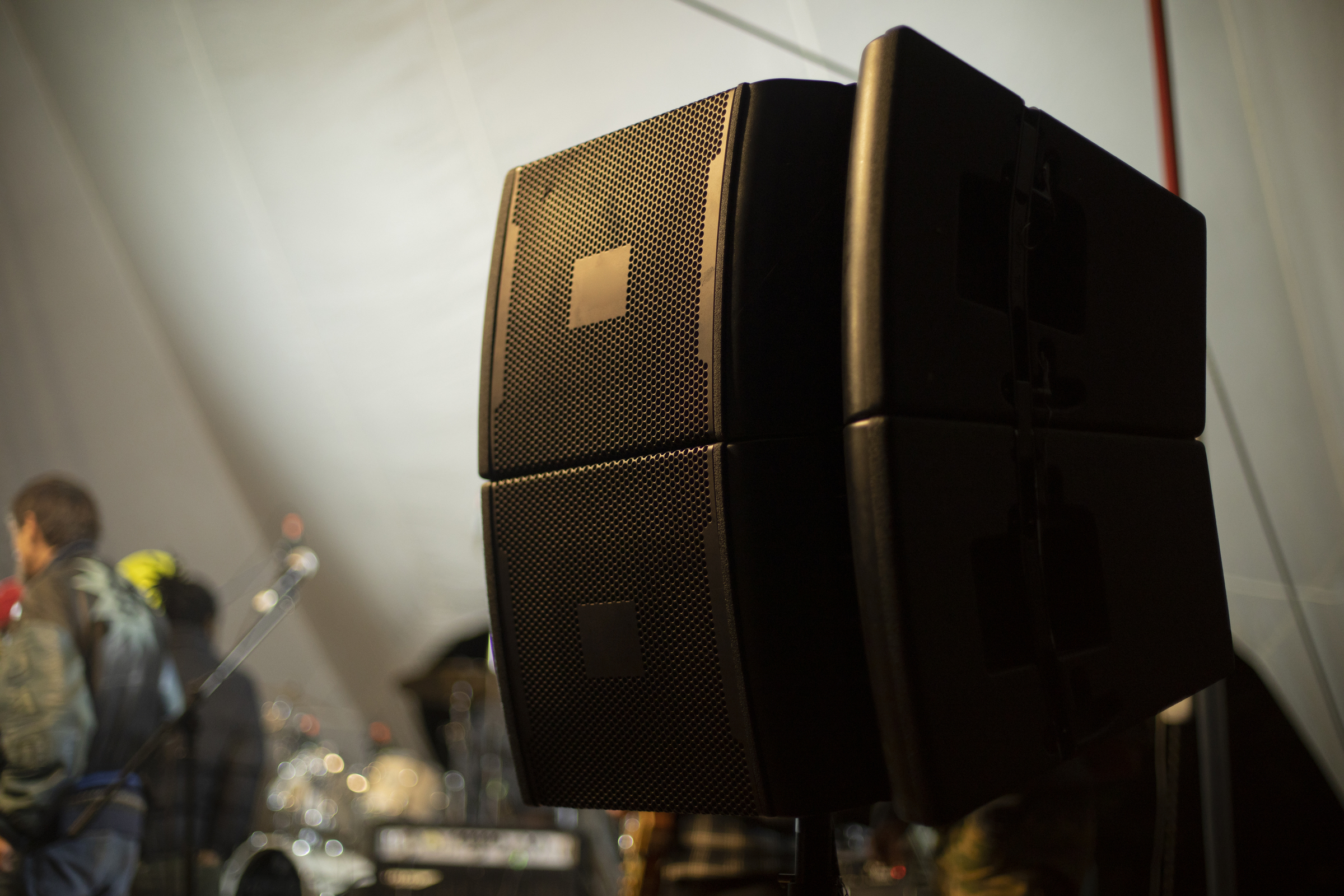
Line array main systems reduce feedback tendency compared to point-source speakers by creating more controlled coverage patterns. d&b audiotechnik‘s ArrayCalc software predicts coverage patterns that inform system design, allowing engineers to minimize energy return to the stage while maximizing audience coverage. L-Acoustics Soundvision provides similar capabilities for their loudspeaker systems. This predictive modeling has transformed system design from iterative experimentation to science-informed optimization—feedback considerations now shape initial design rather than requiring after-the-fact mitigation.
Real-Time Response During Performance
Despite all preparation, live performance introduces variables that soundcheck cannot predict. A singer gestures with their microphone, sweeping it past a monitor. The second act’s guitarist steps forward, placing their vocal mic in a new acoustic relationship with the wedge. The venue fills with bodies, changing the room’s absorption characteristics. The engineer must respond instantly, identifying emerging feedback and addressing it before audiences notice. This reactive skill develops through experience—countless shows build the reflexes that make feedback control appear effortless.
Mute groups and scene automation on digital consoles provide tools for proactive feedback prevention. An engineer might program scenes that pull back monitor sends during sections where performers don’t need monitoring, reducing overall feedback potential. DiGiCo Snapshots and Yamaha Scenes enable these transitions seamlessly. The philosophy shifts from purely reactive feedback suppression to anticipatory gain structure management—knowing when feedback risks increase and adjusting before problems occur. This proactive approach, enabled by digital automation, represents contemporary best practice in feedback-critical applications where even momentary howl is unacceptable.
Mastering feedback control ultimately requires integrating physics understanding, equipment knowledge, room awareness, and performance instincts into a unified practice. The engineer who succeeds makes their work invisible—audiences never hear the near-miss that was caught, the developing ring that was quashed, the resonance that was anticipated and prevented. This invisibility defines professional excellence in stage audio: the absence of problems that never occurred because expertise prevented them.
