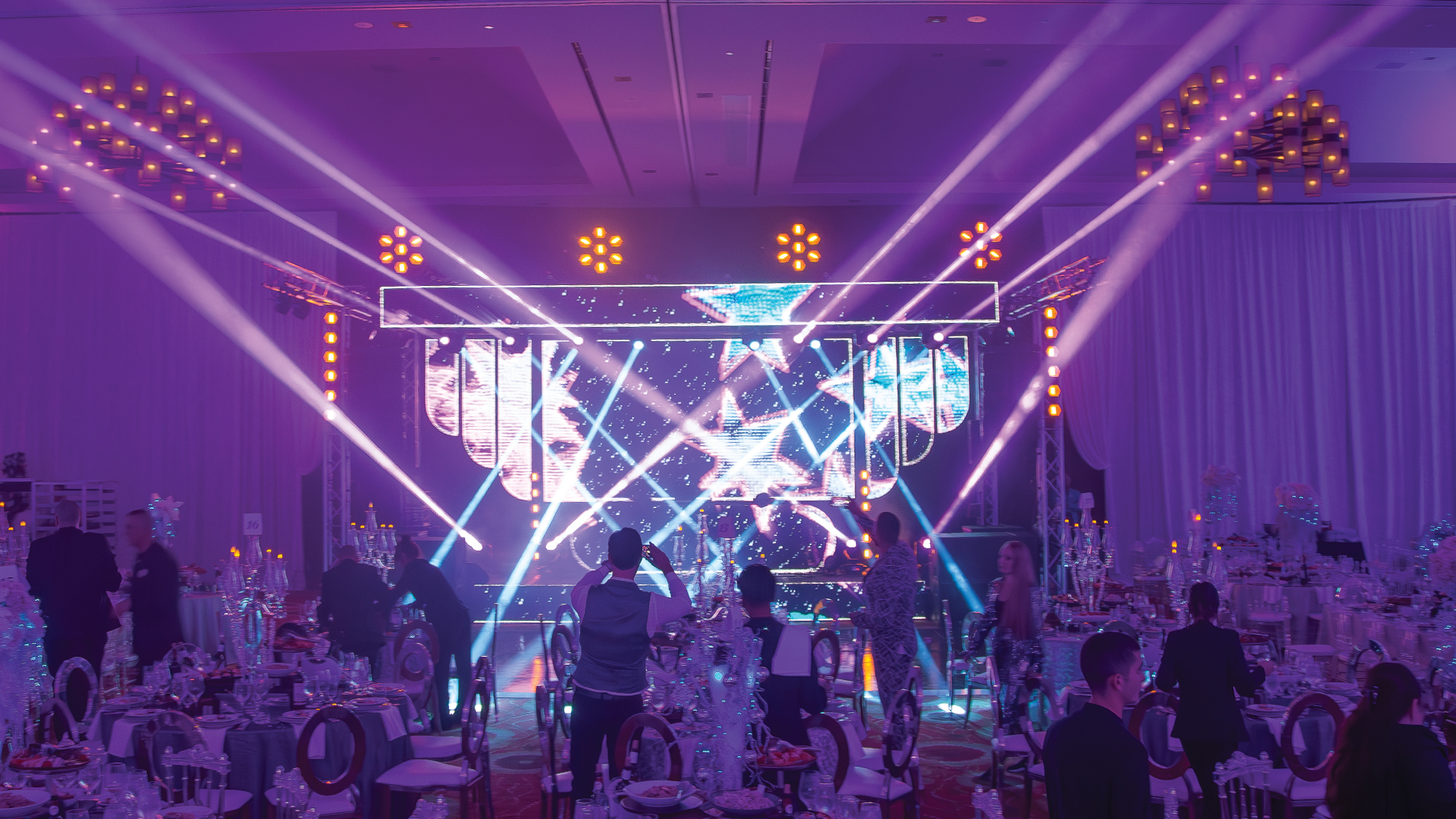
If you have ever watched a live broadcast event where the LED wall behind the presenter appears to shimmer, crawl, or display a pulsing pattern of dark bands — congratulations, you’ve witnessed LED moiré: one of the most technically irritating artifacts in live broadcast production and one that is routinely misattributed to camera problems, processing issues, or broadcast chain failures when it is almost always a camera-to-LED-pixel relationship problem with specific, solvable engineering solutions.
The Physics of Moiré
Moiré is a spatial aliasing artifact that occurs when two regular patterns overlap at frequencies close enough to generate a beating interference pattern. In the context of LED walls and cameras, the two patterns are: the LED pixel pitch — the physical spacing of individual LED clusters in the wall — and the camera sensor’s pixel array. When these two regular grids interact at certain distances and camera positions, they generate a third, visible pattern — the moiré — whose frequency and direction are determined by the mathematical relationship between the two underlying grids.
The phenomenon was described mathematically in the 19th century — the term “moiré” derives from a type of watered silk fabric that displays similar interference patterns — but its relevance to electronic imaging became acute only with the proliferation of high-resolution LED panels in broadcast backgrounds in the 2000s. Early broadcast productions using Barco LED and Lighthouse LED tiles in news and entertainment backgrounds regularly encountered moiré issues for which there was initially limited systematic guidance.
The Role of Pixel Pitch in Moiré Risk
The primary determinant of moiré risk from the LED side is pixel pitch — the center-to-center distance between adjacent LEDs in the panel, measured in millimeters. A 2.6mm pitch panel has 385 pixels per linear meter; a 3.9mm pitch panel has 256 pixels per linear meter. At typical studio and stage distances, finer pitch panels (2.6mm and below) present lower moiré risk to broadcast cameras because the Nyquist frequency of the LED grid falls below the camera’s aliasing threshold — the pixels are too fine to generate a beatnote within the camera’s resolution band.
However, fine pitch is not a complete solution: Absen Acclaim 2.5, ROE Visual RB2.3B, and similar fine-pitch broadcast LED products have dramatically reduced moiré incidence in controlled studio settings, but at greater camera distances or with telephoto lenses, even fine-pitch panels can exhibit moiré under certain conditions. The relationship between pitch, camera distance, and lens focal length must be modeled for each specific deployment.
Camera Distance and Lens Selection
From the camera side, the key variables are sensor resolution, lens focal length, and shooting distance. A 4K camera (3840 horizontal pixels) has a higher spatial frequency capture capability than an HD camera (1920 horizontal pixels), which means it can resolve the LED pixel grid at greater distances and is therefore more susceptible to moiré at those distances. This counterintuitive effect — higher resolution cameras being more prone to moiré — is well documented and affects Sony Venice, ARRI Alexa LF, and RED Komodo sensors used in broadcast-quality live production.
Longer focal lengths compress the spatial relationship between the camera and the LED wall, increasing the apparent size of the pixel pattern relative to the sensor. A 70–200mm zoom at 200mm from a camera 30 feet from an LED wall resolves more individual pixels than a 50mm prime at the same distance. Camera positions that require telephoto coverage of a subject against an LED wall should be identified in pre-production and evaluated specifically for moiré risk.
Anti-Moiré Techniques: Physical Approaches
The most reliable physical intervention against LED moiré is defocusing — deliberately placing the LED wall slightly outside of critical focus so that the pixel structure is optically blurred beyond the camera’s resolution limit. This technique, standard in broadcast LED wall deployments, requires that the LED content be designed with soft edges and gradual transitions rather than hard-edged graphics, because defocusing will also soften any content with fine detail.
A small amount of diffusion material — LEE 250 Quarter White Diffusion or similar — applied in front of the LED wall at a modest distance (6–12 inches) can optically low-pass the pixel structure without significantly reducing brightness or color accuracy. This approach is more commonly used in film production with LED volume stages than in live event contexts, but the principle is applicable where the visual character of the LED background is more important than maintaining pixel-perfect sharpness.
Anti-Moiré Techniques: Camera Parameters
Several in-camera parameters can reduce moiré without physical intervention. Optical low-pass filtering (OLPF) — a physical filter in front of the sensor that cuts spatial frequencies above the Nyquist limit — is built into many broadcast cameras and can significantly reduce moiré. Some cameras allow OLPF strength adjustment; increasing OLPF strength trades moiré reduction for a small loss of fine detail resolution.
The camera angle relative to the LED panel is a surprisingly effective moiré variable. A camera shooting the LED wall at exactly 0 degrees — perfectly head-on — tends to exhibit the worst moiré because the camera’s horizontal pixel array and the LED’s horizontal pixel array are perfectly aligned, maximizing the aliasing interaction. Tilting the camera slightly — even 3–5 degrees from square-on — rotates the relationship between the two grids and can reduce or eliminate the moiré pattern. This is the simplest, free adjustment available and should be the first intervention attempted.
Content Design as Moiré Prevention
The most underutilized moiré prevention technique in LED broadcast production is content design. Pixel-grid patterns, fine horizontal lines, and regular geometric textures in LED content are highly prone to generating moiré. Smooth gradients, organic textures, and out-of-focus abstract imagery are naturally resistant. Working with content designers to bias broadcast-background LED content toward moiré-resistant visual approaches — using Adobe After Effects or Notch to generate motion content with inherent spatial softness — is a proactive technical collaboration that pays dividends throughout the production.
